Driving Textile-to-Textile Recycling in Europe with the RE-APS Project
A turning point for the industry
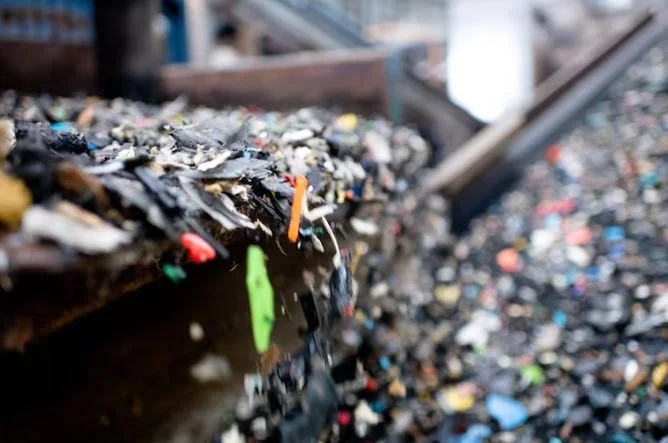
With the 2024 revision of the Waste Shipment Regulation, Europe is entering a new era: exporting plastic waste outside OECD countries will no longer be an option.
The challenge is clear : build strong, local recycling capacities to turn waste into valuable resources.
From textile waste to new textile raw materials
The transition towards a circular textile industry requires more than collecting and sorting end-of-life products. One of the major technical challenges is to transform textile waste into secondary raw materials with sufficient and controlled quality to be reprocessed into new textile products.
This is precisely the ambition of the RE-APS project, funded by the EU and supported by the Interreg France-Wallonie-Vlaanderen programme. The project focuses on the development of thermomechanical recycling solutions for post-consumer and post-industrial polyester textiles, with the objective of reintegrating recycled polyester into textile applications as a priority.
Building on previous laboratory-scale developments, RE-APS aims to move towards pilot-scale validation and prepare the conditions for future industrial deployment.
For CETI, the project also illustrates a broader approach to textile recycling: selecting and developing the most appropriate recycling and transformation route according to the composition of the waste stream and the targeted application.
CETI's role in RE-APS: closing the loop for textile polyester
Within RE-APS, CETI is specifically involved in the pilot-scale transformation of polyester textile waste through thermomechanical recycling and its conversion back into textile materials.
The process starts with the preparation and characterisation of polyester waste streams. Once suitable feedstocks have been identified and prepared, thermomechanical recycling consists in processing the thermoplastic material through melting, filtration and pelletisation in order to obtain recycled polyester pellets.
At CETI, these developments can be carried out using a pilot-scale EREMA recycling line, enabling post-industrial and post-consumer textile waste to be processed under controlled conditions.
But producing recycled pellets is only one part of the challenge.
For textile-to-textile recycling, the decisive question is whether the recycled polymer retains sufficient quality and processability to be transformed again into fibres and textile structures.
CETI therefore connects recycling with its downstream polymer and textile transformation platforms to evaluate the complete pathway: textile waste → preparation → thermomechanical recycling → recycled polymer → formulation / compounding → melt spinning → textile structure → performance assessment.
Within RE-APS, CETI carries out pilot-scale thermomechanical recycling trials and contributes to the transformation of recycled materials through bicomponent spinning and nonwoven, knitting and weaving applications.
This integrated approach makes it possible to identify the relationship between feedstock quality, recycling parameters, polymer properties, spinnability and final textile performance.
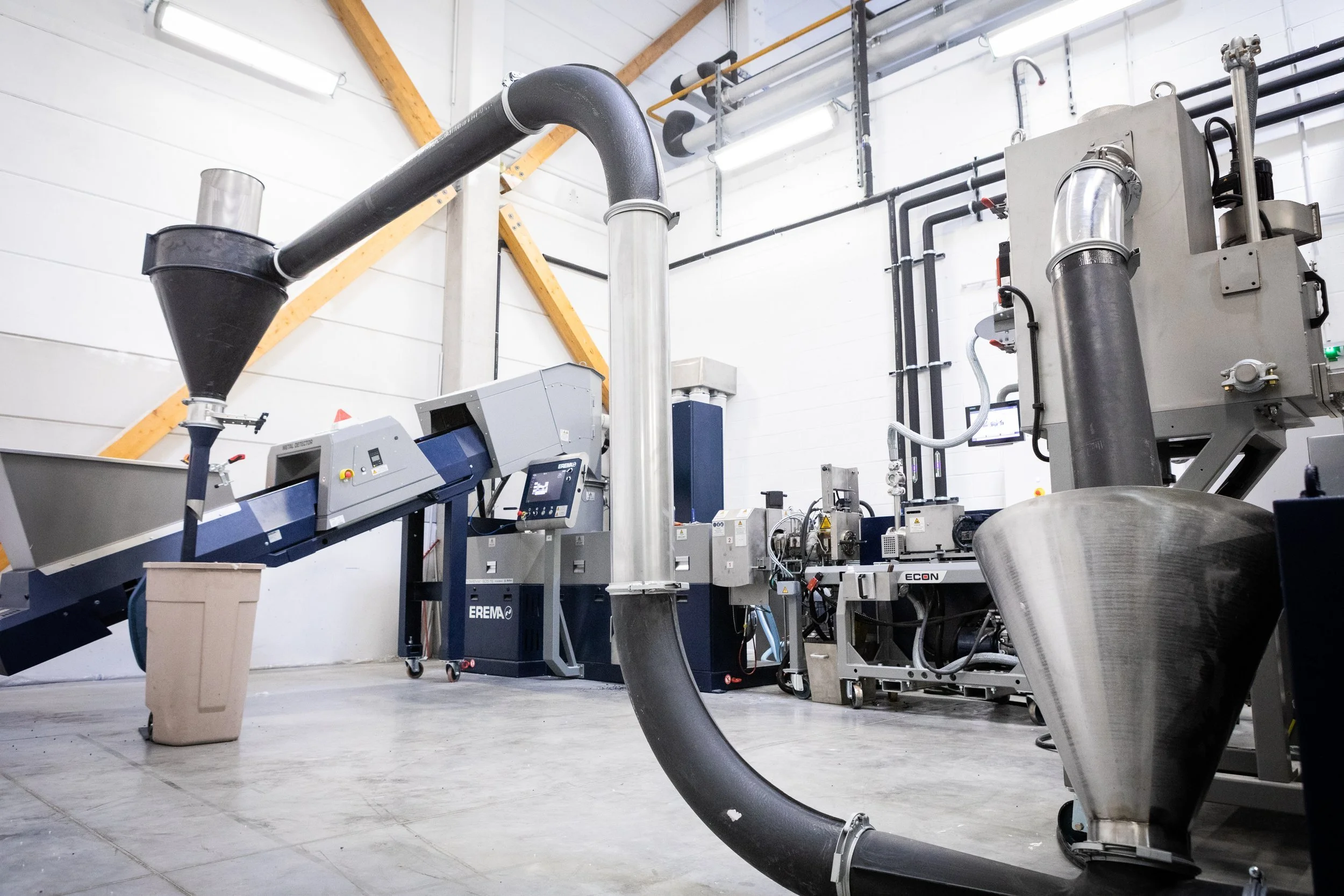
CETI’s pilot-scale EREMA thermomechanical recycling line
From recycled polymer to new fibres
One of the key challenges of thermomechanical recycling is the degradation that polymers may undergo during their first use, their lifetime and successive thermal processing steps.
Recycled polyester therefore needs to be characterised not only in terms of composition and contamination, but also according to properties that directly influence its transformation into fibres.
CETI can assess the behaviour of recycled polymers, optimise formulations and processing conditions and determine whether the resulting material can meet the requirements of textile transformation.
Through its Compounding / Spinning / Fibers platform, recycled polymers can subsequently be formulated and processed to evaluate their suitability for new filament, fibre or nonwoven applications.
The objective is therefore not simply to demonstrate that a textile waste stream can be converted into pellets, but to establish the processing window required to obtain a recycled material that can effectively return to the textile value chain.
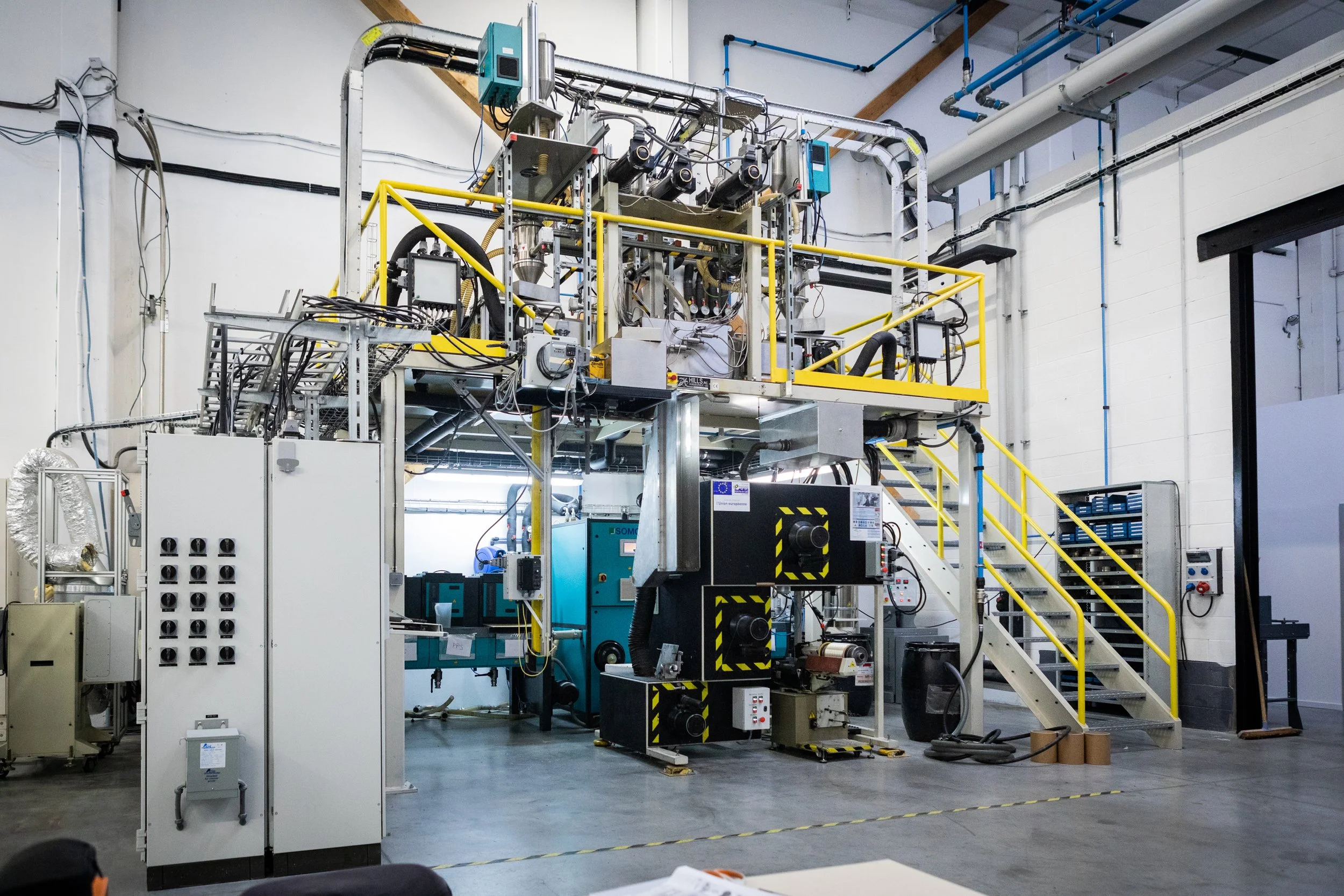
CETI’s Filament Melt Spinning Platform
Different textile waste streams require different recycling routes
Polyester is particularly suitable for thermomechanical recycling when sufficiently homogeneous and properly prepared streams are available.
However, post-consumer textile waste is rarely limited to clean mono-material streams. Garments frequently contain blends of fibres, coatings, elastane, accessories, dyes and finishing chemicals.
Among these complex streams, polyester/cotton blends represent an important challenge for textile-to-textile recycling.
In such cases, melting the complete textile is generally not an appropriate solution because polyester and cellulose behave fundamentally differently during thermal processing. Other recycling strategies must therefore be considered.
CETI's approach is consequently based on combining complementary recycling technologies according to the composition and quality of the feedstock and the targeted end use.
Mechanical recycling: keeping fibres in the textile value chain
When the fibres can retain sufficient physical integrity, mechanical recycling can provide a direct route for recovering textile materials without modifying their chemical structure.
CETI has pilot capabilities covering textile preparation and fibre opening, followed by the transformation of recovered fibres into new materials.
Depending on fibre length, composition, homogeneity and targeted performance, mechanically recycled fibres can be evaluated for applications such as yarn production or drylaid nonwovens, including carding, airlaying, needlepunching and thermal bonding technologies.
For complex blends such as polyester/cotton, this approach can make it possible to valorise the complete blend without necessarily separating its polymer constituents, provided that the recovered fibres remain suitable for the targeted transformation process.
The challenge is therefore to establish the relationship between waste composition, mechanical recycling conditions, recovered fibre quality, incorporation rate and final product performance.
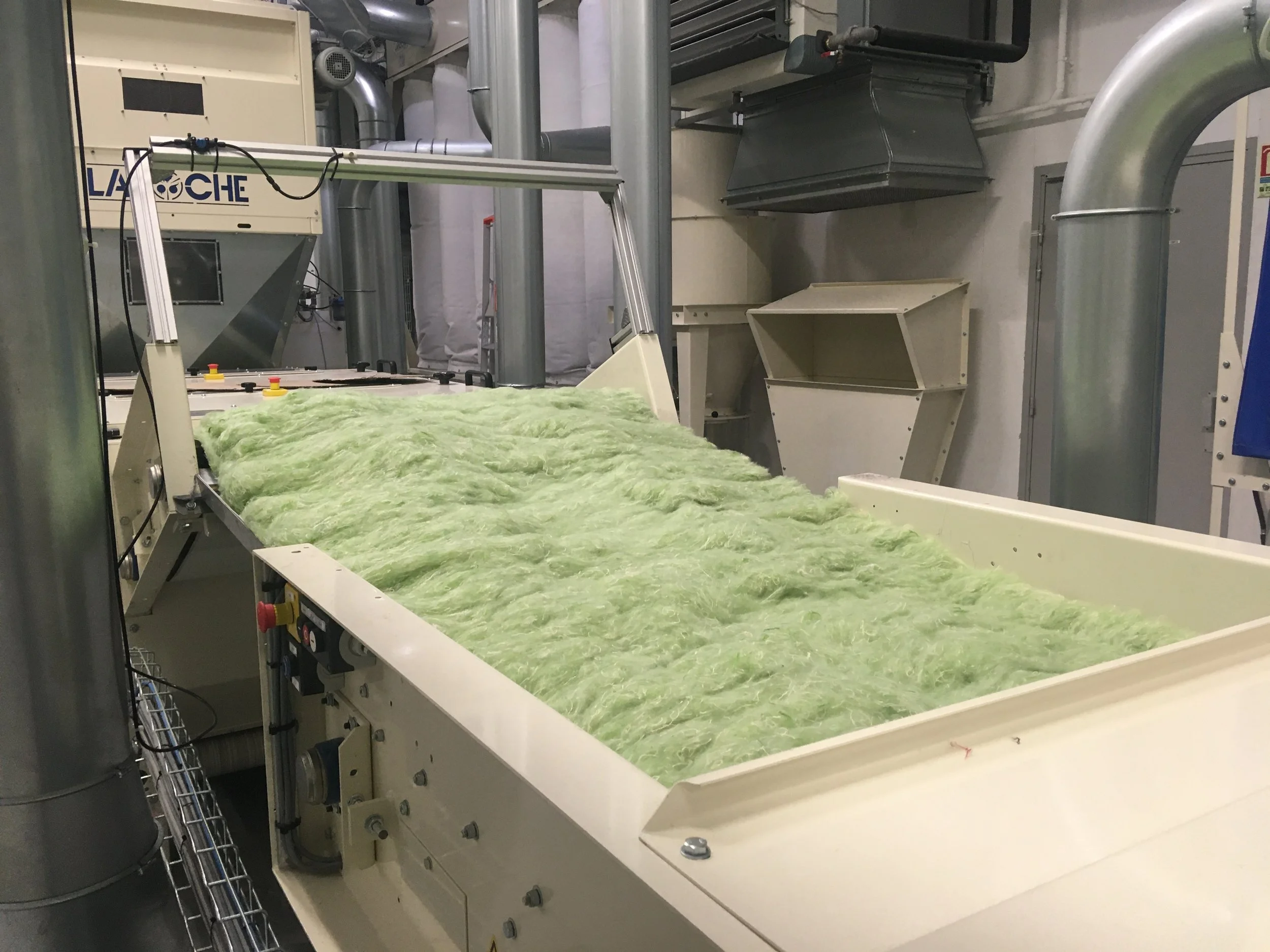
CETI’s pilot-scale mechanical recycling line
Supporting chemical recycling with textile transformation expertise
For waste streams that cannot efficiently be recycled mechanically or thermomechanically, chemical recycling can provide another route towards high-quality secondary raw materials.
Here, CETI's contribution can complement the expertise of chemical recycling technology providers.
After depolymerisation, dissolution or purification, a recycled polymer still has to demonstrate that it can be transformed into a technically and economically relevant textile product.
CETI can support this transition by characterising recycled synthetic materials, adapting their formulation and compounding conditions and assessing their suitability for fibre and textile processing.
The objective is to bridge the gap between the output of the recycling process and the requirements of textile manufacturing.
This can include the development of formulations and processing parameters required to restore or optimise properties such as rheological behaviour, melt processability, filtration behaviour and spinnability before evaluating the material in new textile applications.
Valorising the fractions generated by recycling processes
Complex textile recycling can also generate secondary fractions that should themselves be considered as potential raw materials.
This is particularly relevant for polyester/cotton blends.
Processes designed to recover polyester may leave a cellulose-rich fraction originating from cotton. Rather than considering this fraction simply as a recycling residue, CETI can investigate its potential for further material valorisation.
If the cellulose fibres remain sufficiently preserved, mechanical preparation and fibre-based transformation routes can be evaluated, including their incorporation into yarns or nonwoven structures.
Where the fibres are too short or damaged for conventional mechanical recycling but the cellulose itself remains suitable for further processing, other routes, such as dissolution and regeneration technologies (relying on Wet Spinning processes), may represent longer-term valorisation opportunities.
This approach is essential to maximise material recovery from complex textile waste streams and improve the overall environmental and economic performance of recycling processes.
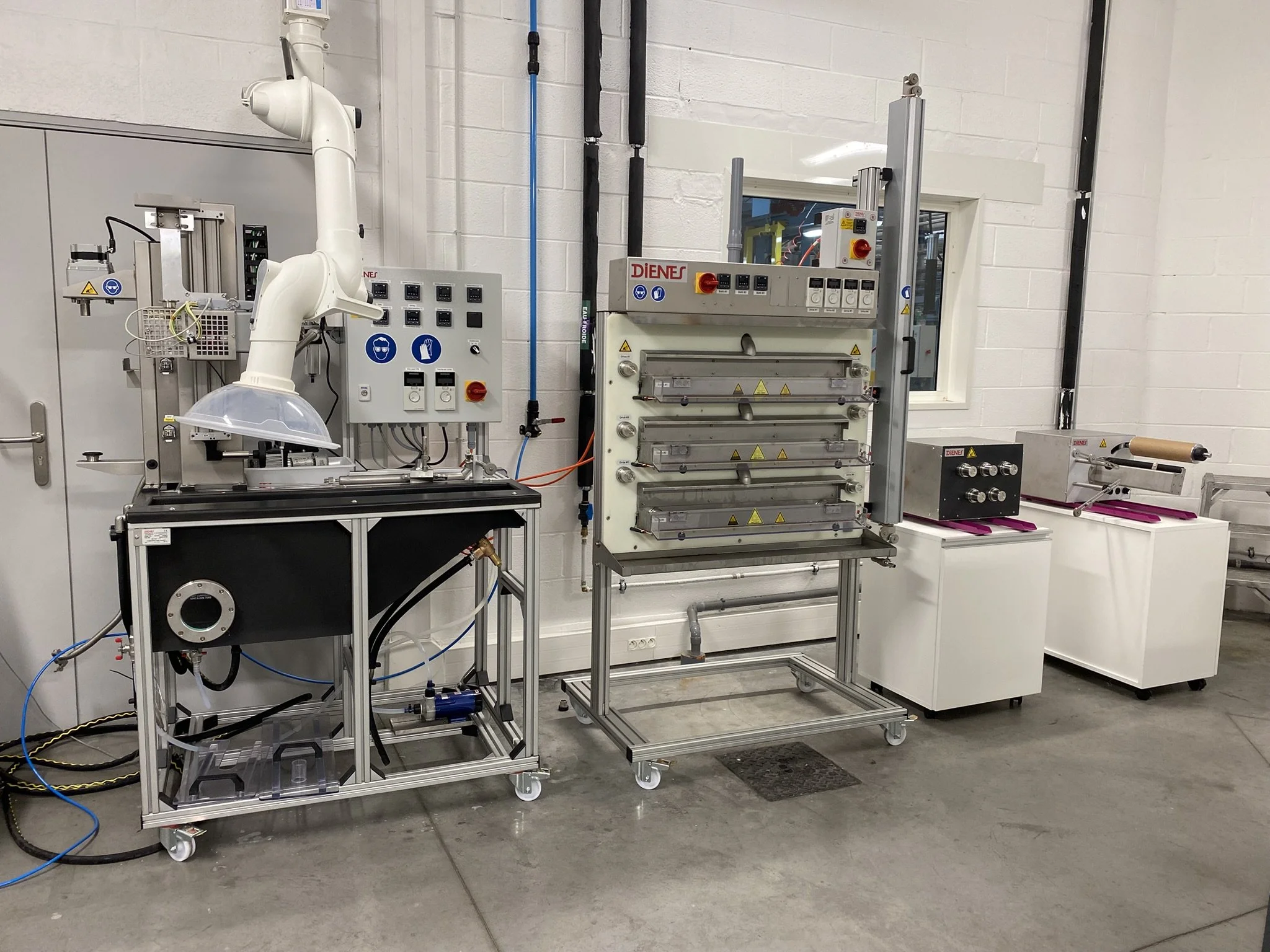
CETI’s pilot-scale Dienes Wet Spinning line
Connecting recycling technologies with textile applications
The development of circular textiles cannot rely on a single recycling technology.
The challenge is to identify the most relevant combination of feedstock → recycling technology → recovered material → textile transformation process → application.
Through RE-APS, CETI is contributing directly to the development of one of these pathways: the thermomechanical recycling of polyester textiles and their return to textile applications.
More broadly, CETI's interconnected recycling, polymer processing, spinning, nonwoven, yarn and fabric platforms make it possible to investigate several complementary pathways:
mono-material thermoplastic textiles: thermomechanical recycling, pelletisation, formulation and reprocessing into fibres or nonwovens;
complex textile blends: mechanical recycling and fibre recovery for yarns, nonwovens and technical materials;
materials produced by chemical recyclers: formulation, compounding and validation of their suitability for textile processing;
secondary fractions from recycling processes: development of new valorisation routes, particularly for cellulose-rich fractions.
By connecting recycling processes directly with pilot textile transformation technologies, CETI helps move the discussion from “Can this textile be recycled?” to the more industrially relevant question:
“Can this waste stream be converted into a controlled secondary raw material and successfully transformed into a new, high-value textile product?”
Building industrial textile-to-textile recycling in Europe
RE-APS brings together EuraMaterials, Fedustria, Centexbel and CETI within a cross-border ecosystem covering materials, textile and plastics expertise.
Centexbel and CETI combine their capabilities for the preparation, characterisation and transformation of polyester waste streams, while the project mobilises stakeholders across the collection, recycling, textile and plastics value chains.
By developing pilot-scale processes, recycled materials, textile prototypes and transferable industrial models, RE-APS aims to help create the technical and economic conditions required for the future industrial deployment of textile polyester recycling in Europe.
For CETI, this project reflects a wider objective: developing recycling technologies together with the applications that will ultimately use the recovered materials.
Because closing the textile loop does not stop at producing recycled material. It requires demonstrating that this material can become textile again.
👉 To learn more about the RE-APS Project
👉 To learn more about our expertise in textile recycling
👉 To learn more about our initiatives in sustainable textiles