REWIND
Rewind
Reinventing the end of life of textile products to design more responsible collections.

The REWIND project is supported by ADEME through the Investments for the Future Programme (PIA).
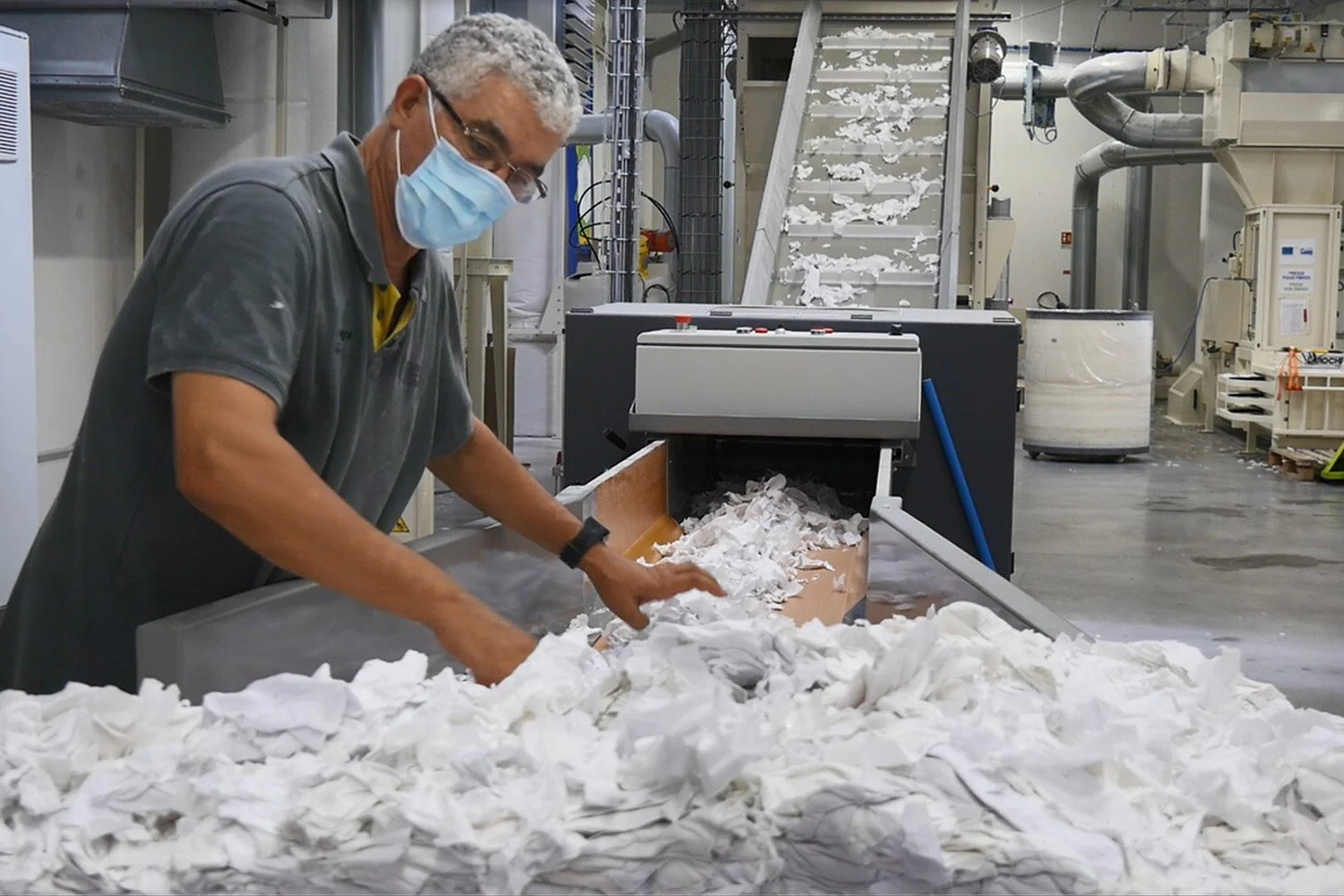
The recycling process is now fully operational at CETI
The fibre opening, carding and spinning processes are now mature, enabling CETI teams to make these capabilities available to brands in order to support both R&D developments and subsequent production phases, including feedstock characterisation, development of recycled yarns, and transfer to industrial scale.
The REWIND project is positioned within the circular economy framework and aims to deploy and operate industrial-scale installations covering the full post-consumer textile recycling value chain, including collection, sorting, dismantling and recycling. The project will deliver operational demonstrators reaching advanced Technology Readiness Levels (TRLs), followed by validation through end-user and customer panels from DECATHLON under real-use conditions.
The successful validation of these trials may lead to the progressive integration of recycled cotton fibres across all industrial productions within the DECATHLON Group in both weaving and knitting value chains. By reinventing product end-of-life pathways, the project supplies the textile industry with a secondary raw material.
Brands and industrial stakeholders will be able to incorporate recycled materials, thereby significantly reducing, in the long term, the use of virgin raw materials as well as product cost structures, while optimising the environmental footprint of cotton fibres.
“Over the six-year project, REWIND will demonstrate a complete closed-loop recycling value chain for post-consumer cotton textiles, from automated sorting and dismantling to fibre opening, spinning and the production of new textiles, paving the way for the industrial-scale use of recycled cotton.”
-
The REWIND project aims to develop and demonstrate a closed-loop textile-to-textile recycling process for post-consumer cotton garments, enabling recycled cotton fibres from discarded textiles to be used in the production of new garments. The project addresses the key technological barriers across the recycling value chain, from the preparation and sorting of textile waste to fibre recovery, spinning and the production of new textiles.
To achieve this goal, the project has defined four main objectives:
To develop reliable and automated sorting and dismantling solutions for post-consumer textiles, enabling waste streams to be efficiently separated according to material composition and colour;
To optimise mechanical recycling and fibre-opening processes in order to recover cotton fibres with sufficient quality for their reuse in textile applications;
To adapt and improve spinning processes for recycled cotton fibres, particularly to overcome the challenges associated with the shorter fibre length resulting from mechanical recycling and to optimise the quality and cost of recycled yarns and fabrics;
To demonstrate the technical and industrial feasibility of a closed-loop cotton recycling value chain, from discarded garments to new textile products, through a pilot recycling platform and the preparation of solutions for subsequent industrial-scale deployment.
-
Committed partners include:
Decathlon France
TDV Industries
CETI – Centre Européen des Textiles Innovants
Synergies TLC
ANDRITZ Laroche
ICAM – Catholic Institute of Arts and Crafts.
-